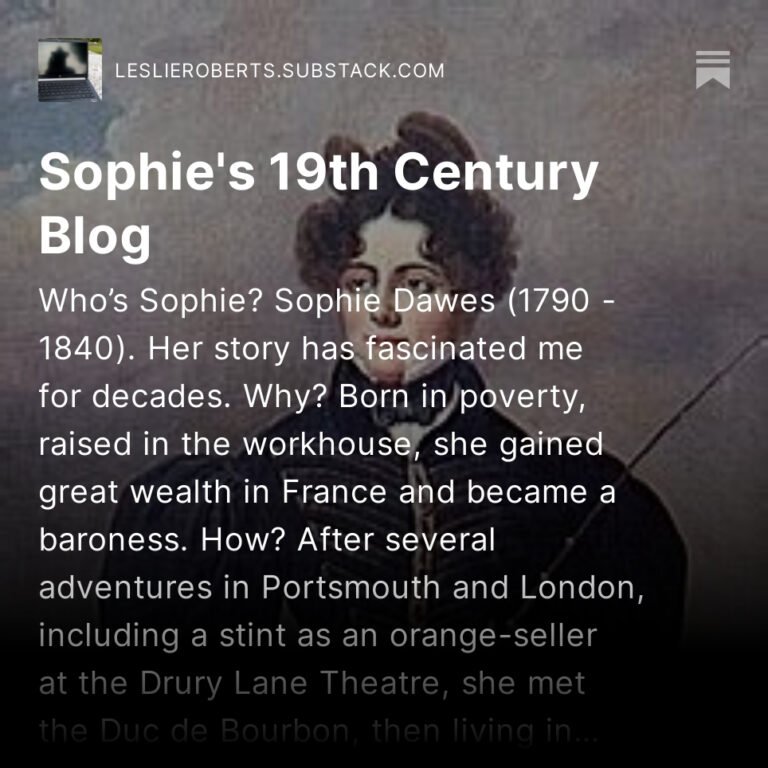
Sophie grabbed my attention when we were on holiday in the Isle of Wight, decades ago. Her waxen effigy stood in the no-longer-extant waxworks at Brading. I was studying French literature and history at the time and the info panel fascinated me. Back at uni, I found a microfiche copy of a Times article from 1840 giving news of her demise and the will she left (I still have a print-out somewhere).
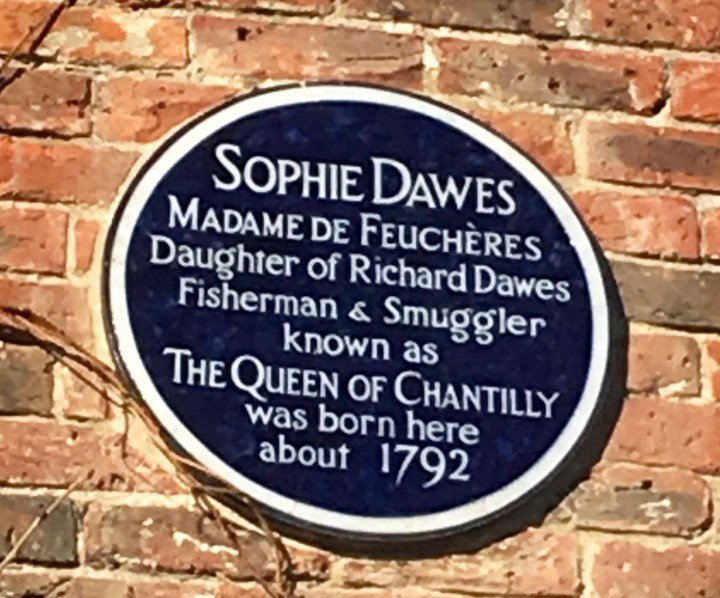
My brother found a biography by Marjorie Bowen (a fascinating lady in her own right). For a while, when the kids were growing up, we spent time most summers visiting her birthplace (blue plaque), the monument she erected for her nephew James (St Helens churchyard),
or tracking down the site of her mansion near Christchurch, UK. (Bure Homage was demolished in the fifties for new housing). All this time I was researching her, making far too many notes, and promising myself I’d write her story one day. I contacted the writer of her entry in the Dictionary of National Biography , but she didn’t know where Sophie was buried, and the info wasn’t in any biography I’d read. I eventually discovered her tomb in Kensal Green cemetery – my proudest moment, though the glory has to go to an Isle-of-Wight blogger who responded to my query.
My wife once referred to Sophie as my ‘other woman’ but loved our adventures tracking down her movements. I thoroughly recommend a visit to Chantilly (they weren’t much help when I e-mailed them to request a decko at their archives). Sophie still fascinates me. As one of my readers said of her: ‘I wouldn’t like her in real life, but her history is utterly fascinating.’
‘Wicked Shore’ has been many things: a huge novel, a trilogy-in-embryo, and a two-volume story, the first of which leans a little lamely rather than being a stand-alone.
I re-worked it to reduce the overall word–count, yet critiquers wanted more detail. When I cut scenes, I felt I ended up with a poor relation of my original – though I may well not be the best judge of which darlings to kill.
Three years ago, I accepted that my ‘finished’ work was unpublishable and shelved it, satisfied I’d at least written the novel I wanted.
Now, I’m once more flirting with the possibility of an edit which might generate some interest. I struggle with cutting scenes, but now I’ve satisfied the creative itch that drove me to write the thing in the first place, I can do so without compunction. (Does that sound ridiculous?)
The ‘disappearance’, of scenes & characters has huge knock-on effects in apparently unrelated chapters. Also, I find myself noticing the ways other writers summarise info which would/should make for highly exciting reading and accept this is done in the interests of a shorter but well-rounded story, with fewer threads, but which still satisfies the modern reader.
The jury is out, but perhaps one should first finish the novel you want to write. Then take a breather. Then regroup.
There an episode in my novel where Sophie meets Paul de Chartres while sitting in the garden at Chantilly. Paul waxes eloquent about (among other things) the genius of the landscape artist André Le Nôtre, who designed the gardens there as well at at Fontainebleau and Versailles.
I’ve just watched Alan Rickman’s A Little Chaos, about the fictional love affair between Le Nôtre – Louis XIV’s ‘gardener’ – and Kate Winslet, who played an entirely fictitious landscape architect in her own right. I enjoyed it, always being curious about others’ perceptions of these characters of the past.

It’s an unusual and, in my view, a fascinating film, which leaves me wondering what mysterious forces prompted Rickman to make it. What a shame there’s not (yet?) an app which allows us to interview dearly-departed geniuses.
Alex von Tunzelmann, reviewing the film in The Guardian, is witty-clever, never actually wrong, and more perceptive than I could ever be. Yet she is unkind.
The film begins (she writes) with a tiny French prince soiling himself at court. (…) Alas, it’s downhill from here.”
She describes le Nôtre as a moody hunk, and points out historical inaccuracies for which of course I take her word. She is arguably justified in describing the plot as contrived (don’t all plots have to be?), the acting as Boho cliché (whatever that means) and the symbolism as heavy-handed.
Much as I chuckled over the scenes between this fictitious assistant Gardener and Rickman as Louis XIV, I couldn’t help but speculate the possibilities of a real encounter between these two social opposites, and admire the imagination that gave birth to the idea. I was somewhat relieved to see other reviews with phrases like beautifully performed; a precious gem of a movie, and a beautifully photographed cinematic romp into the past.
I don’t imagine Mr Rickman claimed historical accuracy. If it were literature, it would be called historical fiction.
I was quite fond of the bishop. In a sense, he was my inciting incident, engaging Sophie, now the Baroness de Feuchères and approaching her 50th year, in conversation, giving her the idea of her writing her life story.
As they spoke, his eyes dropped down to her cleavage, and he blushed at the mention of her past life. He was the first character mentioned in her memoir – or perhaps its preface – and I can’t pretend I didn’t have qualms about murdering this particular darling.
Why did I do it?
The answer has something to do with the first half of my research involving her younger years, from childhood poverty to her adventures as an ingénue on the streets of London, and a a young hopeful in the post-Napoleon Paris of Bourbon restoration. Anyone knowing anything about Sophie Dawes would want to get to the ‘real meat’ of her later life, and the scandals associated with her: her sham marriage, the role she played at Chantilly, the hold she had over the ageing duke and, crucially, her part in his mysterious death.
For good or bad, these are the concerns of my second tome, which begins with Sophie flexing her muscles of her influence as Bourbon’s mistress, when she is introduced to the court of the newly-crowned Louis XVIII, and her growing fixation with the rival d’Orléans faction. In order to keep the mystery of the duke’s death in the reader’s mind, I decided to recount her younger life with flash-forwards, as it were, to later incidents relating to that unfortunate event.
My revised opening to Volume One therefore begins with Sophie’s return from Paris, having met with Maitre Lavaux, the lawyer she hired to protect her good name. She is greeted at her newly-purchased mansion, Bure Homage, by her maid Minette. This latter is concerned that her mistress’s memoir involve the revisiting of events leading to the duke’s supposed murder.
Is Sophie as innocent as she claims?
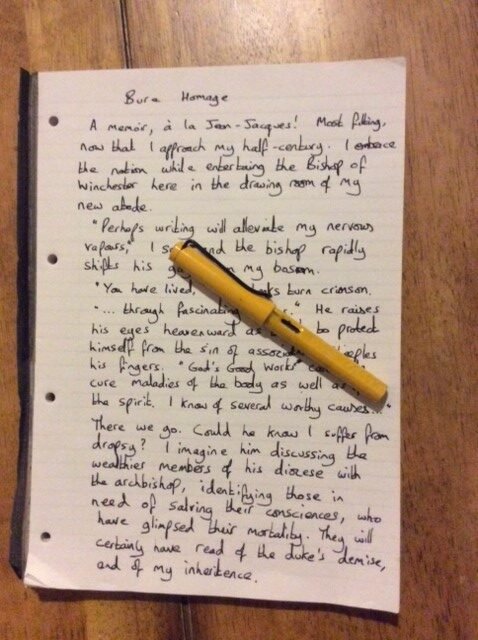
Murdering the Bishop
I was quite fond of the bishop. In a sense, he was my inciting incident, engaging Sophie – now the Baroness de Feuchères and approaching her 50th year – in conversation, giving her the idea of her writing her life story.
As they spoke, his eyes dropped down to her cleavage, and he blushed at the mention of her past life. He was the first character mentioned in her memoir – or perhaps its preface – and I can’t pretend I didn’t have qualms about murdering this particular darling.
Why did I do it?